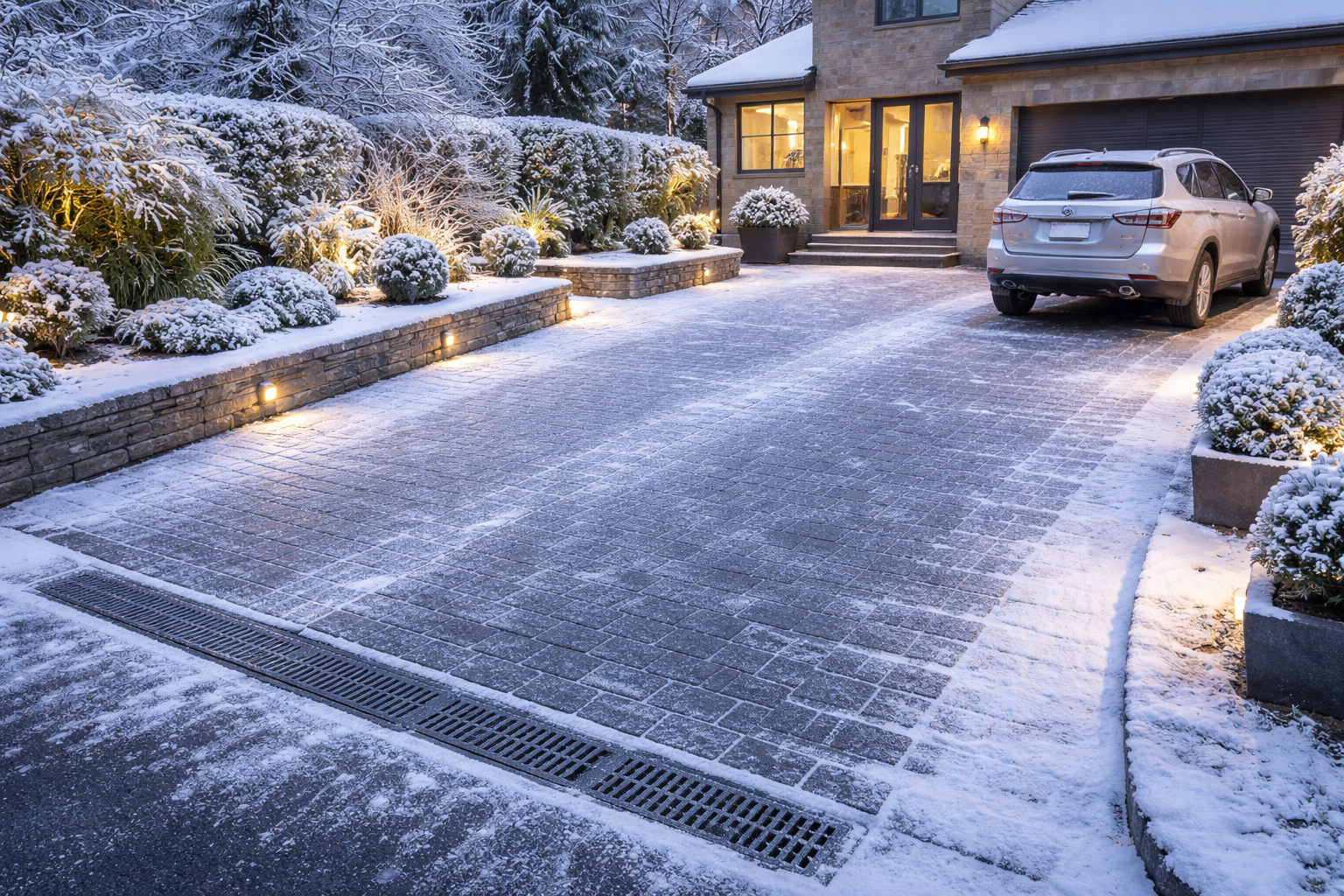
Winter exposes the strengths and weaknesses of a driveway faster than any other season. In Glasgow, where prolonged rain, sudden temperature drops, and repeated freeze thaw cycles are part of normal winter weather, poorly designed driveways rarely last quietly. Cracks appear, surfaces lift, water pools, and ice becomes a safety risk.
Homeowners often assume these issues are unavoidable, a natural consequence of the climate. In reality, most winter driveway problems are not caused by the weather itself, but by design and installation decisions made long before winter arrives.
Drainage
Drainage is not an optional upgrade. It is the single most important factor in how a driveway performs during winter.
When water is allowed to remain on or beneath a driveway surface, it creates three problems. First, it weakens the sub-base. Second, it increases the risk of frost damage. Third, it creates hazardous icy conditions.
A properly designed driveway manages water at every level. Surface water must move away from the driveway quickly. Subsurface water must be controlled so it cannot collect beneath the structure. Both require careful planning rather than guesswork.
Surface Water Management
The surface of a driveway should always have a clear fall. This means it is deliberately sloped so water drains away from the house and does not pool. Even a slight dip can become a problem during winter when standing water freezes overnight.
Permeable surfaces play an important role here. Resin bound systems and permeable block paving allow water to pass through the surface rather than sitting on top. This significantly reduces surface ice and helps manage heavy rainfall common in Glasgow winters.
Sub-Base Drainage
The sub-base is the unseen layer that determines whether a driveway survives winter. A well compacted, free draining sub-base prevents water from being trapped beneath the surface. If water becomes trapped, frost expansion will cause movement, cracking, and surface failure.
Many winter driveway issues stem from insufficient excavation depth or poor quality base materials. These shortcuts are rarely visible until the first hard winter exposes them.
How Frost Damage Actually Occurs
Frost damage is often misunderstood. It is not cold alone that damages driveways. It is water combined with freezing temperatures.
When water penetrates a driveway and freezes, it expands. This expansion exerts pressure within the surface and sub-base. When temperatures rise, the ice melts and the pressure is released. Repeated freeze thaw cycles cause gradual breakdown.
Over time, this leads to cracking, loose blocks, surface lifting, and uneven levels. Once movement begins, water penetration increases, accelerating the damage.
This is why driveways during winter require more than a durable surface. They require a structure designed to prevent water retention at every level.
Ice Formation and Safety Risks
Ice is not just a structural issue. It is a safety concern.
Driveways that allow water to pool or flow incorrectly become ice hazards during cold spells. This is especially problematic on sloped driveways, near entrances, and along pedestrian routes.
Materials also play a role. Smooth, non-slip rated surfaces can become dangerously slick when frozen. Proper material selection combined with good drainage and surface texture reduces risk significantly.
A winter-ready driveway is one that sheds water quickly and dries efficiently. Ice should be the exception, not the norm.
Material Performance During Winter
Different driveway materials respond differently to winter conditions.
Block paving performs well when installed correctly with proper edging and drainage. However, poorly installed block paving can shift during freeze thaw cycles if water enters the joints or sub-base.
Resin bound driveways are particularly effective during winter when installed to specification. Their permeability reduces surface water, limiting ice formation. The key is correct base preparation and resin quality.
Porcelain and natural stone require careful consideration. These materials must be installed with precise falls and appropriate bedding to avoid trapped water. Non-slip finishes are essential in Glasgow’s winter climate.
The common thread is not the material itself, but how it is installed and supported.
How Glesga Garden Guy Designs Winter-Ready Driveways
At Glesga Garden Guy, winter performance is considered from the first site visit. Design decisions are based on how water behaves on the site, how the ground drains, and how the driveway will be used throughout the year.
Every driveway begins with proper excavation and base preparation. Drainage routes are planned deliberately, not assumed. Surface materials are selected based on performance as well as appearance.
This approach results in driveways that remain stable, safe, and visually consistent through Glasgow winters. Problems are prevented rather than repaired.
Thinking About a Driveway Built to Last Through Winter?
If you want a driveway designed specifically for Glasgow’s winter conditions, speak to experienced professionals who understand drainage, frost behaviour, and long-term performance.